Best Wireless WiFi Router by Speed and Coverage

Five routers compared on published band speeds, coverage claims and physical size, with the one pick that fits a dorm desk and the one that fits a backpack.

By Lamar CalhounUpdated 15 min read
On this page
- Best wireless wifi router for students at a glance
- How I screened these five routers for students
- Why the 2.4 GHz number decides this, not the headline speed
- 1. TP-Link AX1800 WiFi 6 Router — Best overall
- 2. NETGEAR WiFi 6 Router 4-Stream — Runner-up
- 3. GL.iNet GL-SFT1200 Opal Travel Router — Best for beginners
- 4. TP-Link AC1200 WiFi Router Dual Band Wireless Internet — Best budget pick
- 5. NETGEAR Nighthawk Dual-Band WiFi 7 Router — Best premium
- Can you even use your own router in a dorm?
- How much coverage does one room actually need?
- What more money buys across these five
- The verdict
- FAQ
The best wireless wifi router for students is the TP-Link Archer AX21, because 574 Mbps on 2.4 GHz is the number that survives a cinder-block wall and a floor of competing networks. If you change rooms every few months, the GL.iNet GL-SFT1200 Opal is the better buy at 0.66 lb and 3.35 x 4.65 x 1.18 in. What actually splits this field is the slow band, not the fast one. Every router here advertises a 5 GHz figure that looks impressive on the box and evaporates two walls away. The 2.4 GHz half is what carries your video call from the desk to the far corner, and that number ranges from 300 Mbps to 574 Mbps across these five.
Best wireless wifi router for students at a glance
| Pick | 5 GHz / 2.4 GHz | Coverage claim | Price |
|---|---|---|---|
Best overall TP-Link AX1800 WiFi 6 Router |
1200 Mbps 574 Mbps |
Beamforming, 4 antennas | Check Price |
Runner-up NETGEAR WiFi 6 Router 4-Stream |
1.8 Gbps combined | 1,500 sq. ft. claim 20 devices |
Check Price |
Best for beginners GL.iNet GL-SFT1200 Opal Travel Router |
867 Mbps 300 Mbps |
Compact, 0.66 lb | Check Price |
Best budget pick TP-Link AC1200 WiFi Router Dual Band |
867 Mbps 300 Mbps |
1,000 sq. ft. claim | Check Price |
Best premium NETGEAR Nighthawk Dual-Band WiFi 7 Router |
3.6 Gbps combined | 2,000 sq. ft. claim 50 devices |
Check Price |





How I screened these five routers for students
I lined up the published specifications for every router in this set side by side and threw out the marketing adjectives. What was left came down to four comparable things: band speeds, coverage claims, physical footprint, and warranty length.
Three screens did the cutting:
- A usable 2.4 GHz figure. Anything advertising only a combined number without a per-band breakdown got harder to judge, which is why the two NETGEAR picks sit below the Archer AX21 despite newer release dates.
- A footprint that fits a shared desk. The Nighthawk RS90 measures 5.2 x 10.8 x 7.09 in. That is a real object on a small desk. The Opal, at 1.18 in tall, is not.
- A published warranty. All five list one. Two years on the TP-Link pair and on the Opal, one year limited on both NETGEAR units.
Worth saying plainly: none of these listings is described as a student router, and none carries a specification aimed at dorms specifically. The keyword implies a product category that manufacturers do not actually build. So the picks here are chosen for the conditions students live under, small rooms, thick walls, shared connections and frequent moves, not because a box says so.
Why the 2.4 GHz number decides this, not the headline speed
Most router guides rank on the big number. AX1800, BE3600, AC1200. That number is the two bands added together, and the larger half of it is the 5 GHz band, which is the half that drops off fastest through walls.
A dorm is the worst case for 5 GHz. Concrete block, steel doors, a laptop on the far side of the room, and thirty other networks broadcasting on the same channels. The 2.4 GHz band is slower on paper and tougher in practice. That's the split that matters.
Look at what the listings publish:
- Archer AX21: up to 574 Mbps on 2.4 GHz, up to 1200 Mbps on 5 GHz
- Archer A54: up to 300 Mbps on 2.4 GHz, up to 867 Mbps on 5 GHz
- GL-SFT1200 Opal: 300 Mbps on 2.4 GHz, 867 Mbps on 5 GHz
The Archer AX21 publishes nearly double the 2.4 GHz ceiling of the two AC1200 units. That difference is WiFi 6 doing work on the band you actually rely on when you're not sitting next to the router. It's the single clearest gap in this set, and it's why the best wireless wifi router for students here is the one with the strongest slow band rather than the one with the highest total.
Also worth knowing: dual-band means no 6 GHz. TP-Link states this outright for the Archer A54, and both NETGEAR picks are described as dual-band too. Nothing in this set gives you a third band.
1. TP-Link AX1800 WiFi 6 Router — Best overall
The Archer AX21 pairs the strongest published 2.4 GHz figure in this set with the slimmest full-size body, which is exactly the combination a shared room needs.
Best for: a shared apartment or a dorm suite with a working Ethernet jack Skip it if: you need something pocket-sized for hotels and libraries
Two things separate this from the rest of the set. First, that 574 Mbps 2.4 GHz ceiling, which is 274 Mbps clear of both AC1200 picks. Second, the body: 1.61 x 10.3 x 5.3 in and 1.1 lb, the lightest of the four non-travel routers here. It lies flat and wide rather than standing tall, so it slides under a monitor riser or onto a bookshelf.
TP-Link claims 1.8 Gbps total bandwidth and credits Beamforming, four high-gain antennas and OFDMA for reaching devices further out. Those are the manufacturer's words, not measurements. What I can verify from the listing is the antenna count and the two-year warranty, which is double what either NETGEAR pick offers. TP-Link also states it's a signatory of CISA's Secure-by-Design pledge.
It's the one buyers choose most often in this group by a wide margin, and it sits third of five on price. The trade-off is age. Released in 2020, it's the oldest design here, and it has no WiFi 7 radio if you're planning five years ahead.
Pros:
- Highest published 2.4 GHz ceiling here at 574 Mbps
- Two-year warranty, longer than either NETGEAR pick
- Lightest full-size router in this set at 1.1 lb
- Low-profile 1.61 in body fits a crowded desk
- Sells faster than the rest of this set
Cons:
- 2020 design, the oldest in the group
- Dual-band only, so no 6 GHz
- No coverage area figure published, unlike the NETGEAR picks
- Needs a separate modem, which TP-Link states explicitly
2. NETGEAR WiFi 6 Router 4-Stream — Runner-up
Same 1.8 Gbps class as the winner, with a published coverage figure and app-guided setup, at a shorter warranty.

Best for: someone who wants app-guided setup and automatic firmware updates Skip it if: a two-year warranty matters to you
The R6700AX lands in the same speed class as the Archer AX21, up to 1.8 Gbps across 2.4 GHz and 5 GHz. What NETGEAR adds is numbers you can measure your own space against: coverage up to 1,500 sq. ft. and up to 20 devices. NETGEAR is careful to note that walls, floors and interference reduce that range, which is honest and also a warning if your building is concrete.
Setup runs through the free Nighthawk app on iOS, Android or a browser, and NETGEAR says your modem needs active internet before you begin. The security list is specific: WPA3 encryption, automatic firmware updates and a guest network. That guest network is genuinely useful in a shared flat, since flatmates get their own password and never touch your main network.
It weighs 1.41 lb and was released in 2025, making it one of the two newest picks here. Two real costs against the winner. It sits fourth of five on price, higher than the Archer AX21 for the same 1.8 Gbps class, and the warranty is one year limited rather than two. The listing also publishes no per-band split, so you're comparing a combined figure against the winner's itemised one.
Pros:
- Published 1,500 sq. ft. and 20-device figures to check against
- WPA3, automatic firmware updates and a guest network
- 2025 release, one of the two newest here
- App or browser setup, no console needed
Cons:
- One year limited warranty against the winner's two
- Costs more than the Archer AX21 for the same speed class
- No 2.4 GHz and 5 GHz split published
- No dimensions listed, so desk fit is a guess
3. GL.iNet GL-SFT1200 Opal Travel Router — Best for beginners
At 0.66 lb and 3.35 x 4.65 x 1.18 in, this is the only pick here you can carry between a dorm, a hotel and a library.
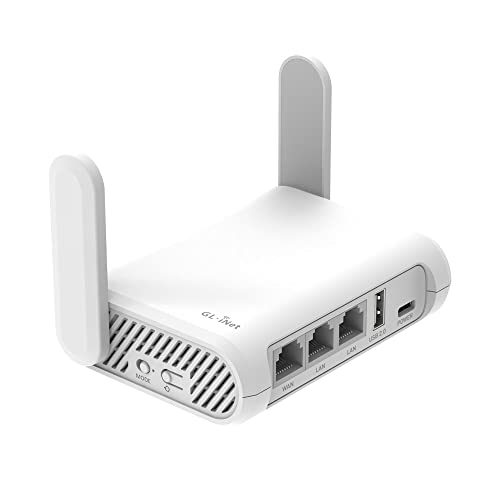
Best for: anyone moving between dorms, hotels and sublets Skip it if: you need to cover a whole apartment
This is the outlier, and it's here on purpose. Students move. The Opal weighs 0.66 lb, GL.iNet lists it as a 145 g design, and its footprint is smaller than a paperback. Nothing else in this set travels.
The band speeds match the budget Archer A54 exactly: 300 Mbps on 2.4 GHz, 867 Mbps on 5 GHz. Where it differs is the port layout and the software. You get two Gigabit LAN ports and one Gigabit WAN port, so wired devices connect directly. GL.iNet says OpenVPN and WireGuard come pre-installed with support for 30-plus VPN providers, plus IPv6 and Cloudflare encryption. On a network you don't control, that's the whole point of carrying one: your own trusted network sitting behind whatever the building offers.
GL.iNet points you to a manual and an unboxing video for setup, which is a fair signal that this one takes more reading than a phone app. Two-year warranty listed. Only one seller stocks it, and it's second-cheapest of the five. The trade-off is raw reach. Compact hardware means compact coverage, and no square footage figure is published at all.
Pros:
- Smallest and lightest here at 0.66 lb
- Two Gigabit LAN plus one Gigabit WAN port
- OpenVPN and WireGuard pre-installed per GL.iNet
- Two-year warranty, matching the TP-Link pair
- Second-cheapest of the five
Cons:
- No coverage area figure published
- 300 Mbps on 2.4 GHz, tied for lowest here
- Only one seller lists it
- Setup leans on a manual rather than a guided app
4. TP-Link AC1200 WiFi Router Dual Band Wireless Internet — Best budget pick
The cheapest of the five, with WPA3 security and a 1,000 sq. ft. coverage claim that suits one room rather than a house.

Best for: a single room on a slow internet plan Skip it if: you own newer laptops and phones with WiFi 6 radios
If your plan delivers a few hundred Mbps, the Archer A54 stops being a compromise. TP-Link publishes 867 Mbps on 5 GHz and 300 Mbps on 2.4 GHz for 1200 Mbps total, and states plainly that dual-band routers do not support 6 GHz. Coverage is claimed at up to 1,000 sq. ft. with four external antennas, the lowest published figure in this set and still more than a dorm room.
Two features are worth flagging. WPA3 is listed, so you're not stuck on older encryption despite the entry price. And Access Point mode lets it convert a wired connection into wireless, which is exactly what you want if the building already runs its own router and you just need your own wireless network hanging off the wall jack.
It's the cheapest of the five with a two-year warranty, released in 2021, and it weighs 1.45 lb at 1.5 x 5.7 x 9.1 in. The honest limits: it's WiFi 5, so newer devices won't use their faster radios, and it's the slowest seller among the TP-Link and GL.iNet picks here. If you'll keep this router past graduation, the Archer AX21 ages better.
Pros:
- Cheapest of the five
- WPA3 encryption listed at the entry price
- Access Point mode for building-supplied wired jacks
- Two-year warranty
- Published 1,000 sq. ft. coverage claim
Cons:
- WiFi 5, so no WiFi 6 gains on newer devices
- 300 Mbps on 2.4 GHz, tied for lowest here
- Lowest coverage claim in the set
- Heaviest of the two TP-Link picks at 1.45 lb
5. NETGEAR Nighthawk Dual-Band WiFi 7 Router — Best premium
The only WiFi 7 pick, with a 2.5 Gig internet port and a 50-device claim that makes sense in a shared house, not a single room.

Best for: a four-person house sharing one fast connection Skip it if: your plan tops out well under a gigabit
The RS90 is the most expensive pick here and the only one built on WiFi 7. NETGEAR lists BE3600, up to 3.6 Gbps across 2.4 GHz and 5 GHz, and describes that as 1.2x faster than WiFi 6. It also carries a 2.5 Gig internet port, the only above-gigabit WAN connection in this set, and claims up to 2,000 sq. ft. of coverage for up to 50 devices with MU-MIMO and OFDMA handling the traffic.
That device count is the real argument. Four flatmates with two phones, a laptop, a console and a TV each will pass 20 devices, which is where the R6700AX's claim stops. NETGEAR notes some gateways and combo modem-routers may need bridge mode, worth checking before you order.
Then the size. It measures 5.2 x 10.8 x 7.09 in, making it by far the largest object in this set and roughly four times the height of the Archer AX21's slim body. On a dorm desk that's a problem. Warranty is one year limited, half the TP-Link coverage. And it's the slowest seller of the five. Unless your connection actually exceeds a gigabit, most of that 3.6 Gbps stays theoretical.
Pros:
- Only WiFi 7 pick, up to 3.6 Gbps claimed
- 2.5 Gig internet port, the only one above gigabit here
- Highest published claims: 2,000 sq. ft. and 50 devices
- Nighthawk app setup with remote speed tests and device pausing
Cons:
- Largest body here at 5.2 x 10.8 x 7.09 in
- One year limited warranty, shortest in this set
- Most expensive pick, and its speed needs a very fast plan
- Slowest seller of the five
- No weight listed
Can you even use your own router in a dorm?
This is the question that decides whether you buy anything at all, and no listing answers it. Check your housing rules before ordering. Many buildings ban personal routers outright because a second wireless network interferes with campus coverage and can trip network security systems.
Three situations, three answers:
- You have your own wall Ethernet jack and permission. Any pick here works. The Archer AX21 is the default.
- The building runs its own wireless and forbids new networks. Skip full-size routers. The Opal is designed to sit behind someone else's network and give you a private one, which is a different setup from broadcasting your own SSID.
- You're in an off-campus flat with a cable or fiber modem. You have the most freedom. NETGEAR notes the RS90 pairs with an existing modem or gateway over Ethernet and works with most cable, fiber, DSL and satellite providers.
One detail people miss: every router here needs a separate modem. TP-Link states it directly for the Archer AX21. None of these is a modem-router combo, so if your provider gave you a single box doing both jobs, you may need bridge mode. NETGEAR flags exactly that for the RS90.
How much coverage does one room actually need?
Less than you think, and the published claims here overshoot a single room by a wide margin.
Three of these listings publish a square footage figure. The Archer A54 claims up to 1,000 sq. ft. The R6700AX claims up to 1,500 sq. ft. The RS90 claims up to 2,000 sq. ft. A typical double dorm room is a fraction of the smallest of those.
So coverage is not your constraint. Two other things are:
- Wall material. Both NETGEAR listings state that walls, floors and interference reduce range. Concrete and steel do more damage than drywall, and coverage figures are measured under friendly conditions.
- Device count. This is the one that bites in shared housing. The R6700AX claims up to 20 devices, the RS90 up to 50. Count what's actually connecting: phones, laptop, tablet, watch, console, speaker, TV stick. Four people cross 20 fast.
If you're in one room alone, buy on the 2.4 GHz figure and ignore square footage. If you're sharing an apartment with three others, the device claim is the number to read.
What more money buys across these five
The spread here is genuinely useful, because each step up buys something you can point at.
At the entry end, the Archer A54 and the Opal both give you AC1200 speeds, 867 Mbps on 5 GHz and 300 Mbps on 2.4 GHz, plus a two-year warranty. What you're choosing between is coverage or portability, not speed.
The middle step, the Archer AX21, buys a WiFi 6 radio and that 574 Mbps 2.4 GHz ceiling. It's the biggest single jump in this set for the smallest step in price position, which is why it wins.
Above that, the R6700AX buys published coverage figures and app management, not more speed. It's the same 1.8 Gbps class as the Archer AX21 at a higher price position with half the warranty. Genuine value only if the Nighthawk app and the guest network matter more to you than two years of coverage.
At the top, the RS90 buys WiFi 7, a 2.5 Gig port and headroom for 50 devices. That's real capability. It's also the biggest box here and needs an internet plan fast enough to use it, which most student housing does not have.
The verdict
If you're one or two people in a room or a small flat, the Archer AX21 is the best wireless wifi router for students and the pick I'd start with. It publishes the strongest 2.4 GHz figure in this set at 574 Mbps, it's the slimmest full-size body at 1.61 in, and its two-year warranty outlasts both NETGEAR picks. Third of five on price, first in the specification that decides real-world reach.
If you're four people sharing one connection, the Nighthawk RS90 is the answer instead. The cutoff is 20 devices. That's where the R6700AX's published claim stops and where the RS90's 50-device figure starts earning its price. Below that line, you're buying a 2.5 Gig port your plan can't fill and a 5.2 x 10.8 x 7.09 in box your desk can't spare.
The runner-up's exact advantage over the winner is documentation, not performance. The R6700AX publishes a 1,500 sq. ft. coverage claim and a 20-device figure, plus WPA3, automatic firmware updates and a guest network you can hand to flatmates. The Archer AX21 publishes no coverage figure at all. If you want a number to check your floorplan against before you buy, that's worth the shorter warranty.
FAQ
Is a WiFi 6 router worth it for a student on a slow plan?
A WiFi 6 router is worth it mainly for the 2.4 GHz gain, not the headline speed. The Archer AX21 publishes 574 Mbps on that band against 300 Mbps for the AC1200 picks. Even on a modest plan, that's the band carrying your connection through a wall to the far corner of a room. Your plan caps throughput, not reach.
What is the best wireless wifi router for students in a dorm room?
The best wireless wifi router for students in a dorm room is the TP-Link Archer AX21, provided your building allows personal routers. Its 1.61 in profile fits a shared desk, and the 574 Mbps 2.4 GHz band handles thick walls better than any other pick here. Check housing rules first. Some buildings ban a second wireless network entirely.
Which is better, the Archer AX21 or the NETGEAR R6700AX?
Better depends on whether you want published coverage figures or a longer warranty. Both sit in the same 1.8 Gbps class. The R6700AX claims 1,500 sq. ft. and 20 devices, plus a guest network and app setup, on a one-year limited warranty. The Archer AX21 publishes a 574 Mbps 2.4 GHz split and two years of coverage, at a lower price position.
Do I need a modem as well as one of these routers?
You need a modem as well as any router here. TP-Link states this outright for the Archer AX21, and NETGEAR describes the RS90 as pairing with your existing modem or gateway over Ethernet. None of these five is a combo unit. If your provider supplied a single box doing both jobs, bridge mode may be required.
What is the most common mistake buying a router for student housing?
The most common mistake is buying for headline speed instead of checking building rules and device count. A 3.6 Gbps router does nothing on a shared campus connection, and some dorms forbid personal networks. Count your actual devices too. Four flatmates easily exceed the 20-device figure the R6700AX publishes, which pushes you toward the RS90's 50.
Order the Archer AX21 if your room has a wall jack and permission, and set it up flat on a shelf rather than tucked behind a desk where the four antennas fight your furniture. If you're not sure the building allows it, the Opal is the safer buy at 0.66 lb, because it works behind someone else's network and travels with you when the lease ends. What makes the Archer AX21 the right default is not that it's fast on paper. It's that the band you actually depend on, the slow one, is nearly twice as capable as anything else in this set.